
Why Do I Need Dental Care If My Teeth Don’t Hurt?
By Dr. Layla Lohmann, DDS
November 11, 2026
Why might I need dental care if my teeth do not hurt?
Some problems, including early tooth decay, can develop without pain. An examination and appropriate diagnostic records help establish whether you need preventive care, monitoring, or treatment. The recommendation should be explained in terms of your findings, not symptoms alone.
You come to a dental appointment feeling fine, and then you hear that a tooth needs attention. It is reasonable to wonder: If nothing hurts, why do anything?
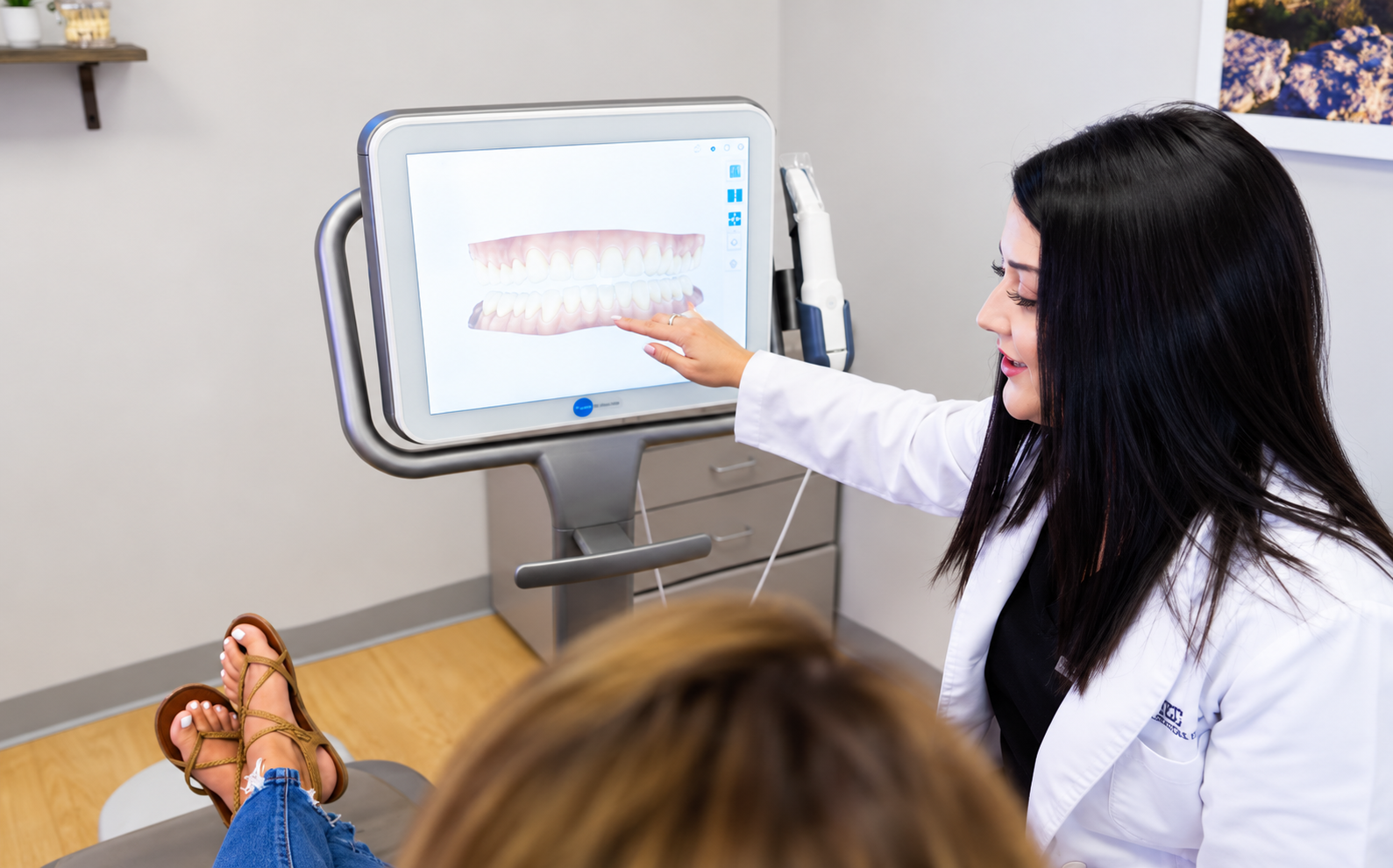
At Dallas Dental Group, I want to answer that question by showing you what I see—not by asking you to accept a recommendation on blind trust. I use a dental health scan on a patient-facing screen to help connect our conversation to your own teeth.
But the scan is not where I start. First, I ask what you want from your oral health: comfortable eating, better function, confidence in your appearance, or fewer problems down the road. That answer gives the images a purpose.
Can a Tooth Have a Problem Without Hurting?
Yes. For example, early tooth decay often has no symptoms. How a tooth feels is only part of the picture.
I sometimes describe the mouth as an environment that experiences its own weather. There are everyday exposures from what we eat and drink, along with the forces our teeth handle. Think of the hurricanes and ice storms in that analogy as a way to understand accumulated challenges—not a prediction that your teeth are destined to fail.
My goal is to help you understand your starting point. What do your teeth look like today? Where do I see a concern? What might we be able to protect?
That is a different conversation from waiting until something hurts and then asking how to fix it. It is also different from assuming every visible change needs treatment.
What Does a Dental Health Scan Help Me Understand?
In my appointments, the scan helps you see the areas I am discussing after we have gathered your diagnostic records. Instead of trying to imagine a finding from a verbal description, you can look at it with me.
Three common areas I discuss are caries, meaning tooth decay; periodontal disease, meaning gum disease; and malocclusion, meaning the way teeth fit together is misaligned. The scan gives us a visual starting point for explaining concerns, but it is not a stand-alone diagnosis of all three.
For example, evaluating gum disease involves examining the gums and measuring the spaces around teeth; X-rays can show bone loss. A surface image does not replace those findings.
What matters to me is that you can follow the reasoning. I want you to understand what I am pointing out, how it relates to your goals, and why I am discussing a particular option.
What Do Small Dents or “Potholes” in Teeth Mean?
Small depressions can be signs of tooth wear, although their appearance alone does not establish the cause. This is one of the examples I use when showing patients their scans: a worn area can look like a little pothole or crater.
Viewing the tooth as a model makes that change in shape easier to appreciate. It gives us something specific to discuss rather than simply saying that a tooth is wearing down.
The cause matters. Acid erosion and mechanical wear are different processes that can occur together. Acid dissolves tooth mineral; tooth-to-tooth contact can also wear surfaces down. Calling all wear “erosion” misses that distinction.
When wear extends through enamel, it can expose dentin, the layer underneath. The American Dental Association describes this as a possible consequence of more severe erosion. A small-looking depression does not automatically mean that has happened.
Depending on the findings, I may discuss protecting an area, sealing it, or restoring it with composite filling material. I also consider what could keep damaging the tooth. If grinding is involved, a night guard may be part of that discussion; mouth guards can help protect teeth from grinding-related damage.
The point is not simply to fill a pothole. It is to understand why it developed and what protection makes sense.
Does Finding Something Early Always Mean I Need a Filling?
No. Early decay may be stopped or reversed before a cavity forms. Finding a concern is the beginning of a decision, not an automatic instruction to drill.
In my decision-making, I consider your diet, habits, ability to clean your teeth, age, and long-term goals. Manual dexterity matters because a plan needs to account for what you can realistically manage at home.
A crack adds another layer of judgment. The type, location, and extent of a crack help determine treatment. A superficial enamel line is not the same as a deeper structural crack, and age alone should not decide whether someone receives a filling or a crown.
What I am trying to weigh is the condition of the tooth alongside the person it belongs to. A recommendation should make sense for both.
I sometimes explain progression as a small restoration becoming a larger restoration and eventually a crown. That is a possible path, not an inevitable sequence for every tooth. My aim is to reduce the chance of needing more involved care—not to promise that early treatment will prevent every future problem.
What Questions Should I Ask About My Dental Treatment Plan?
Start with what matters to you and ask how the recommendation supports it. I do not want dentistry to invade your life, but I do want your oral health to have a place in your priorities.
Sometimes I ask what you enjoy eating or drinking. That is not a test. It helps me connect the discussion to something meaningful to you instead of handing you a list of instructions without context.
Useful questions to ask during our conversation include:
- Can you show me the area you are concerned about?
- What do the examination and records tell us about it?
- What are my options, including monitoring if appropriate?
- What are the risks of waiting, and what should I do at home?
You remain the decision maker. My responsibility is to explain my recommendation and the risks and limitations of the available choices, including declining treatment.
I cannot guarantee an outcome. What I can do is help you understand the situation well enough to make an informed choice—and connect that choice to habits you can maintain between visits.
Schedule a Visit to Discuss Your Preventive Dental Care Options
If you would like to understand a finding or discuss preventive care, schedule a visit at Dallas Dental Group in Dallas, TX. We can look at your records together, discuss what matters to you, and work through the options. To arrange an appointment, contact 972-644-1998.